
Spells & Magic
The Magic Circle: History and Use
Read about the history and legacy of magic circles from their construction, utilization, meanings, and why they are still used today.
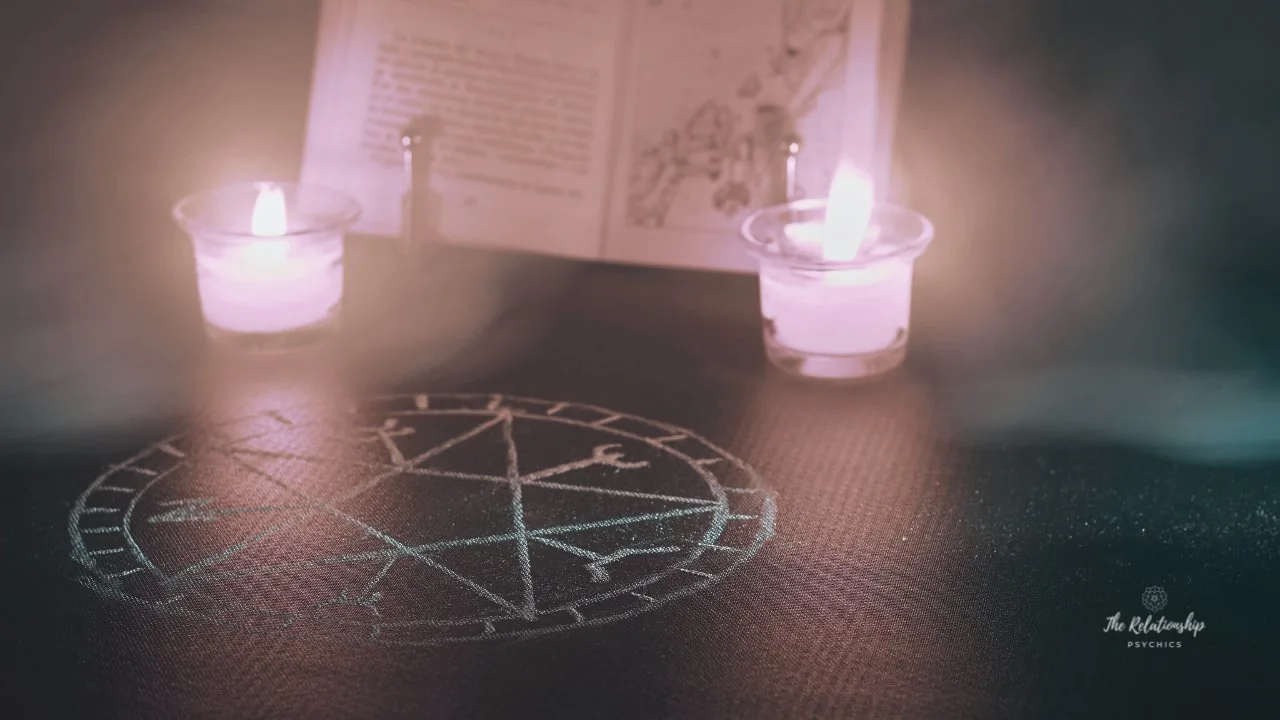
The magic circle — also known as the magic circle of protection, ritual circle, witch’s circle, and even sacred circle — is one of the most iconic trademarks of magic.
You’ll see this circle, or something similar, on the floor, on a piece of paper, or just a group of witches holding hands and forming a circle. This circle carries a powerful legacy called a Magic Circle from ancient Greece, medieval England, and Renaissance Italy to modern times.
Scholars, historians, and occultists have documented the versatility and practicality of this simple seal, showcasing its use and meaning throughout the ages.
Even though we may not discuss the magic circle technique or how to cast a magic circle, we will go over how the circle of protection was used and look at the symbolism of a process magically!
What is The Magic Circle?
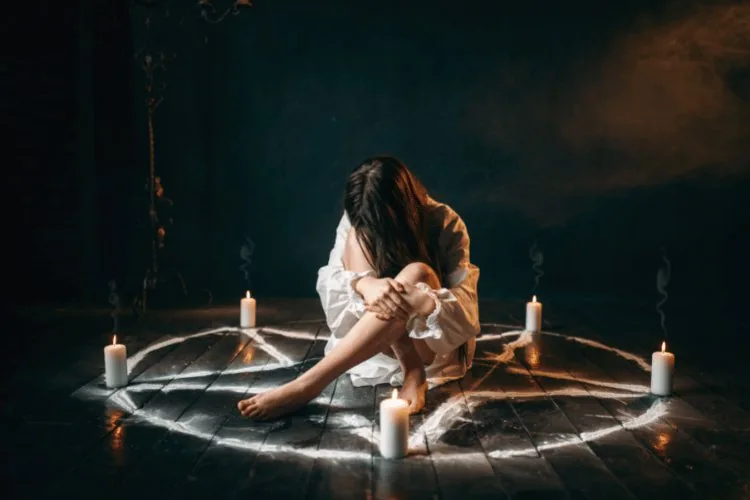
A magic circle is a sacred space that practitioners of ritual magic believe contains energy. Someone can physically mark the ring with salt, flour, chalk, or whatever is available.
Or it could be mapped and drawn out with your finger. The sacred space marked contains containment, divinity, power, and protection.
As M.J. Beijer, author of The Necromantic Magic Circle, puts it, “Like any other form of art, ritual magic uses patterns and symbols which are universally part of human culture and thus, according to Mathiesen, ‘they are also universals of magic.’” The circle is part of this universal culture.
As we’ll see, many traditions and groups implement casting a circle in their practices. Attributions differ according to geographical location and personal philosophy, but the goal is there.
Multiple Uses of Magic Circle
The magic circle is essentially a magical seal or sigil. It has the practical use of being versatile and straightforward to create.
You can draw a simple, unadorned, intricate circle with other markings, seals, and symbolism.
The seals and symbolism serve the purpose of correspondence. It allows the practitioner to connect more with the energy. It also helps them get into the right mindset.
It’s used in many magical settings. A prominent example is using a magic circle as a magical protection.
Magical Protection, Banishing, and Cleansing
In popular culture, you might have seen people making salt circles around their beds and the perimeters of their homes. Salt is a cleansing agent, and the magic circle represents complete unity.
The circles act as a protective barrier against evil forces and negative energy. The magical protection from the process acts as a banishment of evil spirits.
When combined with an herb or mineral, cleansing energy. For example, the circle becomes more than a protective barrier with salt or hyssop. It is also a medium that purifies and removes negative energy.
Evoking, Invoking, and Binding Spirits
To evoke a spirit means to call upon the essence, the feeling, the aura, and the energy of that spirit. To invoke a spirit means to call upon their physical presence around you or within you — to call upon a heart in either manner. A sacred space physically marked can be necessary. The sacred circle is a barrier between you and the spirit, the only area where a soul can roam.
Inside the circle, you can keep candles, incense, herbs, and other offerings to spirits. These rituals involve angelic forces, demonic forces, ancestor veneration, and more!
You can also cast a circle to bind a spirit or energy to an object. If you have a poppet doll, amulet or charm, or any object of choice, you can cast a circle around the thing and use a spell to imbue the essence and power of the entity into the doll.
Sacred Geometry, Wholeness, and Self-Eating Snakes
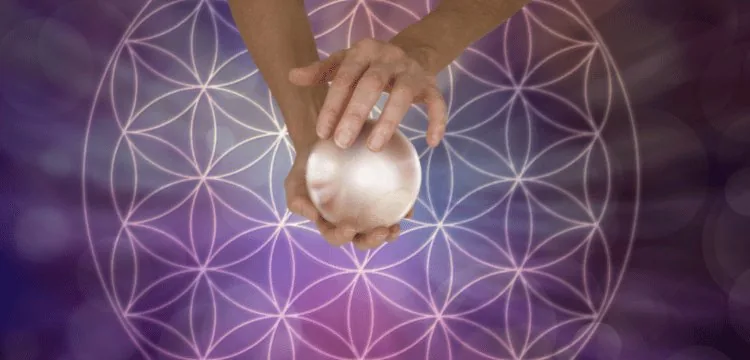
They considered geometry holy teaching in antiquity. Scholars and wise men of old deemed the circle sacred and studied it along with other divine natural sciences in studying the stars and mathematics.
At the time, they saw mathematics as a discipline to aid in communication with their gods. Ritual magicians utilized solving geometric equations like squaring the circle. We see this in the mystical teachings by Pythagoras.
No, this isn’t a flashback to your middle school math class and learning the Pythagorean theorem — but the Pythagorean theorem and other geometries held more than just practical application.
To people like Pythagoras, the world was made of geometry out of numbers. It was communication with the gods.
To understand more about the symbolic purpose of the magic circle, we’ll take you through three different representations of the process.
The One and the Circled Dot

The circle held the meaning of completion.
It symbolized protection because it was a barrier between the individual and evil spirits. It symbolized being connected to nature as it resembled the womb and the earth; it represented the more excellent whole everything is part of; it represented the self-containment that the ultimate Source had.
Everything comes from number one, and you can make as many copies from this original one. To Pythagoras, the circle represents the number one, describing the origin of all.
This number one idea was crucial to later Greek philosophers like Plotinus, Proclus, and Iamblichus. These three were part of a movement called Neoplatonism. This movement has affected modern mysticism in the West like nothing else.
Neoplatonism further developed the idea of the “One,” or monad. In other cultures, like Ein Sof (the Endless One) in Kabbalah, we see this idea.
The circled dot represents the monad. In astrology, they used the circled dot as a planetary glyph for the Sun. The primary base of the Nazar, the blue-eye-shaped amulet, protects one from the evil eye. The circled dot is also used to represent Keter, known as the crown or the highest will, in Kabbalah.
[[
](https://therelationshippsychics.com/wp-content/uploads/2023/11/PsychicsDraw-1200-×-300-px.hevc_.mp4)](https://shop.therelationshippsychics.com/optinskydp5t2)
Ouroboros
Ouroboros is the snake (or dragon) eating its tail and forming a circle. It profoundly symbolizes the cycles of life and nature, rebirth, eternity, and self-sufficiency. The self-eating snake entered Greek philosophy and religion from ancient Egypt and spread into Western thought. This became an important symbol in Western occultism, alchemy, and mysticism.
A rich history of the self-eating snake began in Neolithic China with the Yangshao culture. Historians believe such markings were primarily for pottery decoration around 5000 BC. The rich magical symbolism of the ouroboros was considered to be from Egypt. King Tut’s sarcophagus is the first representation of the ouroboros on a shrine.
Ancient Egyptians gave the circular shape of the ouroboros symbolic importance. Some believed that the ouroboros was a protective barrier around the Sun or was the Sun itself. They became associated with their sun gods and primordial deities who created the world.
This imagery is rooted in real life, as snakes can begin eating under stress or can’t regulate their body temperature.
All these examples are to show how vital the circle is symbolic. When we cast a ring in a ritual, the collective cultural energy humans have imbued into the process over centuries is present.
All the ideas of the circle: protection, cleansing, beginning, eternity, and more, are energetically present within our collective consciousness.
In conclusion, now that we understand how they used the circle, let’s look into the history of magic circle casting, furthermore, how people used ritual circle magic.
The Magic Circle Stood the Test of Time
Manly P. Hall once said, “The most primitive and fundamental of all symbols is the dot [circle].”
Now, we will look at the magic circle of protection and how they used it throughout time and cultures.
Mesopotamian Magic
In Mesopotamia, called the cradle of civilization, most people created rituals. Both individually and as a community. The Sumerians called the use of ritual circles Zisurrû.
Sumerians used a common technique in casting ritual circles. They drew the circle with flour or chalk. They spread the flour around figurines of deities and figures of protection entities. For example, I, An, and Enlil were all gods of Mesopotamia and are within the seven gods. Sumerians believed they attributed to the gods with this ritual.
The type of flour was crucial as different grains held unique properties. Wheat flour specifically invoked deities. Barley encircled beds to protect against disease-causing demons, and šemuš-flour repelled ghosts.
Archaeologists have also discovered the use of magic circles. Similarly, not on the ground but in pottery. Written on the bowls, called “incantation bowls.” In spirals were magical words of invocation, multiple names of deities, and seemingly “nonsense” words that hold mystical power.
Greek Magic
In Greece, Magic circles were protective necessities. However, this motif of the circle as protection against negative spirits is a constant theme in all cultures.
The ancient Greeks used prayers from priests as a spoken magic circle.
Charles Stewart, the author of Magic Circles, says,
“An exorcism prayer for clearing a space of evil spirits describes how the priest’s blessing establishes a circular ‘boundary of fire’ within which all terrestrial, aerial, and astral spirits will be bound and rendered subordinate to Christ and the saints.”
Medieval and Renaissance Magic
The medieval ages and the Renaissance saw a boom (or a rebirth, even!) of magic. Authors and magicians such as Giordano Bruno, Heinrich Cornelius Agrippa, and even Nicholas Culpeper used ancient papyri, philosophical texts, and grimoires to advance their practices.
They wrote their grimoires and texts and preserved and traded old texts—magic from their old days before Christ used and developed further.
Grimoires are magical manuals that contain philosophical information.
In medieval grimoires, the magic circle became essential for ritual magicians. They used elaborate patterns within circle markings to call upon the force they wanted to interact with. Sacred mathematical divination, like magic squares, to write inside the ritual circle.
Many times, planetary and angelic magic used magic squares. The magic square corresponds to the celestial ruler of a planet or archangel.
They used magic squares, gematria, and other esoteric standard techniques to gather more information about the entity.
Hermetic Magic, Golden Dawn, Thelema, and Others
A significant tradition exists within the magical Hermetic Order of the Golden Dawn. They named this tradition the Lesser Banishing Ritual of the Pentagram or LBRP.
Physically, you will draw out pentagrams representing the four cardinal directions. The archangels are usually the magic circle and will not have markings. The figures you draw and envision form a protective circle around you.
This is an elaborate process that requires some practice!
We wrote an in-depth and step-by-step guide to mastering this sacred practice. For instance, that article discusses how the LBRP became a staple in modern occult routines. As well as how to make it a part of your monthly energy cleanse.
Wiccan Tradition
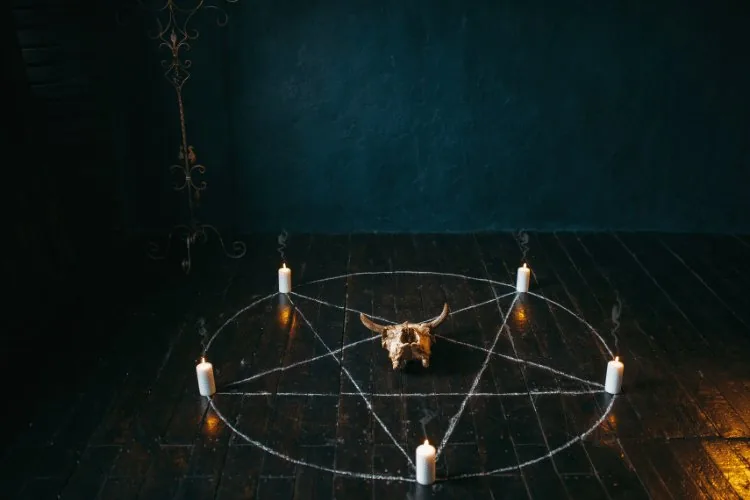
Typically, a Wiccan magic circle is nine feet in diameter. However, the size of the space marked can vary depending on personal philosophy and geographical location. Therefore, it is up to the preference of the caster.
If one is in a smaller room, outside, or doesn’t have many traditional materials, one can use what’s available to them or draw a circle and visualize it with their finger.
You can temporarily exit the circle, dance around the process, or do anything you wish inside the ring! This is an open and flexible tradition — casting a magic circle, and its attributions differ according to practitioners, like if the person is in a group or a solitary practitioner.
To learn more about Wicca and Wiccan rituals, check out this article!
Last Words
How you choose to use the magic circle is up to you! Make it as symbolically rich as you want or as simple as possible. There are many rituals and different magic circle techniques!
In conclusion, now you know the traditions and how they implemented and used the magic circle. It may help you understand how and when to use it.
Do you think a magic circle is necessary? How often do you use one?
[[
](https://therelationshippsychics.com/wp-content/uploads/2023/11/PsychicsDraw-1200-×-300-px.hevc_.mp4)](https://shop.therelationshippsychics.com/optinskydp5t2)
Looking to chat with a psychic now?
Connect with our psychics right away by installing our app Mystica Psychic Readings.